Q-Force & Internet Shame: A Review of Netflix’s Latest LGBTQ+ Comedy
This review was originally published on Medium.
WARNING: Major Spoilers for Season 1 of Q-Force
The internet is missing out on one of the best LGBTQ+ shows of the season.
Towards the end of Pride, Netflix dropped the teaser for Q-Force, an animated show about LGBTQ+ spies. The show was met almost immediately and unanimously with derision. Most people criticized the show’s apparent vulgar, sexual humor and stereotypical characters, particularly homing in on a character absurdly named “Twink.” As of today, the first teaser has 9.6k likes and 115k dislikes. Ouch. The second trailer, released a month later, did not fare any better. So it was decided. Months before the show was released, Q-Force was branded as an unequivocal flop, and at best a transparent attempt to pander to the queer community. It had been lumped into the notorious category of internet content, saved for the most deranged Karens and most awkward teenagers: cringe. The show finally premiered last week, and with a current 25% Rotten Tomatoes score, it seems like that was end of Netflix’s ill-fated LGBTQ+ adult animation comedy.
Yet with the release of the full season, the reaction online has not been one of open schadenfreude. Contrary to what one might think, most people are not reveling in the joyous confirmation of their worst suspicions. For the people who have seen the season, reception has instead been sheepishly positive, with many genuinely enjoying the show’s sense of humor, cast of characters, and queer representation.
When I first saw the trailer in June, I was intrigued, but wasn’t particularly hopeful. Raunchy adult animation has long been the domain of a certain kind of person, and it felt almost regressive. The novelty of shock value comedy animation has long since expired, and bygone are the days when South Park and Family Guy were offering bleeding edge commentaries on American culture. Admittedly, I was surprised the show was even greenlit in 2021, and I assumed it was going to fade away into obscurity, much like one of Netflix’s earlier tepid forays into LGBTQ+ adult animation, Super Drags.
Super Drags was a Brazilian adult comedy featuring animated drag queens as superheroes. While hiring some serious drag star power (Pablo Vittar, Shangela, Trixie Mattel, etc.) and vaguely touching on topics such as the rise of conservative evangelical fascism, the show was by no means a satisfying examination of queer people or their struggles. It didn’t help that a lot of the humor was lost in the translation of the dub. Super Drags often felt like a show that trivialized and caricatured gay people — something that Q-Force was quickly accused of when the trailers first dropped.
So is Q-Force the crass, cringeworthy, stereotypical, juvenile series the internet had made it out to be?
Well, yes? And no?
Meet the Q-Force
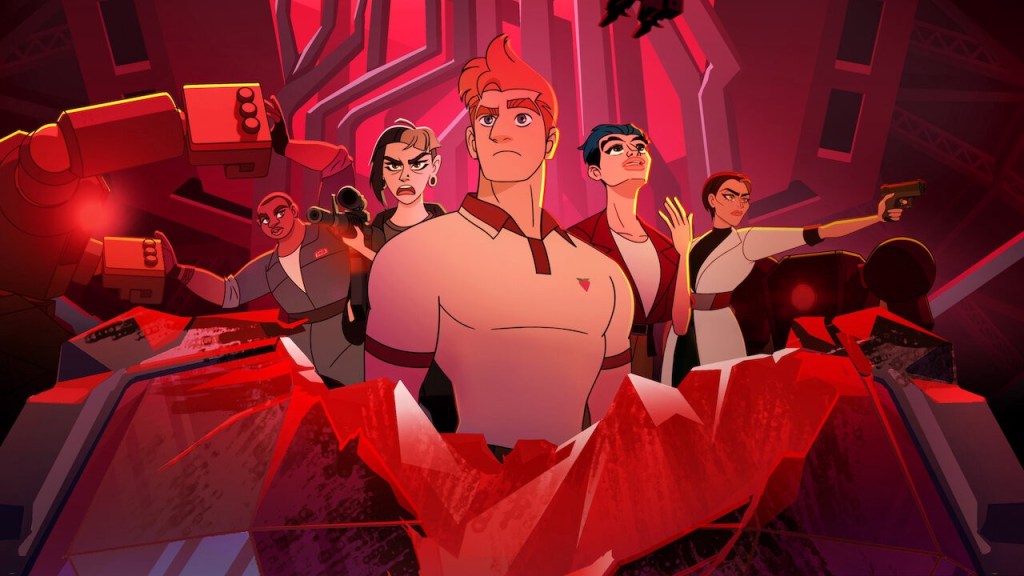
The show centers on the titular Q-Force, a team of LGBTQ+ agents working for the AIA, a fictional CIA-type espionage organization. The team is led by Steve Maryweather, nicknamed Mary (Sean Hayes), an all-American elite agent and valedictorian of the AIA academy. Mary, despite his talents, had been sidelined from service for ten years after publicly coming out as a gay man. His team (based in West Hollywood of course) consists of enormously talented yet overlooked queer agents such as Deb (Wanda Sykes), a mechanic and butch, Stat (Patti Harrison), a gothy hacker, and Twink (Matt Rogers), a young, skinny drag queen. They are later joined by V. (Laurie Metcalf), their commanding officer, and Buck (David Harbour), an experienced, albeit oafish straight AIA agent.
If it seems like I just listed a bunch of gay stereotypes, you’d be right. Q-Force is keenly aware of this, however; rather than informing the character’s identity, the stereotypes function more like LGBTQ+ archetypes, and become the jumping off point from which their characters are more thoroughly explored.
Deb, who covers as a mechanic, is a brilliant engineer and top-notch survivalist. She and her wife, Pam, have the healthiest relationship depicted. Stat, the perpetually aloof hacker-goth, constantly shows up for her friends in ways she doesn’t always personally understand but is more than happy to provide. Even Mary, leader of Q-Force, whose perpetually overlooked elite skills would make anyone arrogant and entitled, often defaults to the expertise of his teammates.
Finally, the controversially named Twink is an effete, skinny drag queen who serves as the team’s Master of Disguises. Twink is almost every gay pastiche rolled into one — a sassy, self-obsessed, vulgar, cross-dressing, limp-wristed airhead. Twink is the kind of character one typically writes off as existing solely for comedic effect, but the show actively resists this. From the first episode, Twink is shown to be highly adept at his job, creating flawless disguises and gathering indispensable intel for their missions.
All this being said, the show’s sense of humor does steer juvenile, and often, incredibly dated (seriously, does anyone under 30 even know who Debra Winger is?). It plays with a lot of stereotypes that sometimes come across as forced or tired, but never derogatory or pejorative. The jokes are never designed to humiliate a character, but to make us laugh in recognition. I know that person, and I love them, one is almost tempted to say. To borrow a tired phrase: we laugh with them, not at them, and that makes all the difference.
For all its problems, the show has heart. There’s a certain hopeful vision of LGBTQ+ culture written into the show, but I think one that constructs a positive model of queerness and queer family. Each queer character is positively portrayed, and they all carry a sense of love, trust and respect for one another.
One of my favorite moments from the show happens in the very first episode, which explores Twink’s backstory and his strained relationship with his father. This is exacerbated by the recent inclusion of Buck to the team, who has been completely dismissive of Twink. By the end of the episode, Twink, who has been plotting to show up Buck with his impressive disguise skills, decides that he has nothing to prove to his boorish colleague, that his approval is not something desirable or even necessary for his own peace of mind.
There’s an admirable freedom that Twink displays; he acknowledges that Buck will continue to think poorly of him, but now, he knows it doesn’t matter. He knows his worth and value exists outside of others’ inability to recognize it. Twink decides he doesn’t need Buck’s (and by extension, his father’s) approval, getting to the core of the series’s theme and setting up many of the character’s arcs.
Seeking Approval
This moment foregrounds the trajectory of the series: the call to overcome the desire for approval from heteronormative and patriarchal institutions. At the start of the series, Mary’s motivations are ultimately assimilationist. Though largely well-intentioned (Mary often advocates for his team and never asks them to hide or change), he constantly seeks approval from the institution that actively excludes him. His desperation to prove himself and his team to the AIA is the driving force of the team’s adventures. Even V., his superior and the only woman in the AIA leadership hierarchy, constantly held Q-Force back. V. preaches a kind of “Keep your head down, work hard, and you will be rewarded” mentality that many marginalized peoples with an iota of power will recognize — to protect your own fragile position of authority, do what the higher ups say and never make waves. However, as is often case in life, all this waiting is never rewarded, as Mary and his team have been benched for ten years.
By the end of the show however, both Mary and V. have both firmly abandoned the inclination towards approval. The team goes rogue when they discover that the AIA had wiped the memories of retired queer agents, to keep their service a secret. It’s a fantastical plot, but not one without its real-life parallels. One calls to mind Alan Turing, who was chemically castrated for being gay, despite his invaluable work intercepting and cracking German codes and messages during World War II. Or Leonard Matlovich, the dishonorably discharged Air Force sergeant, whose epigraph famously reads “When I was in the military, they gave me a medal for killing two men and a discharge for loving one.”
The show’s best quality is that, despite being a comedy, it takes its queer characters’ motivations and fears seriously. Through all the stereotypes, these characters hit home, and touch on a struggle that is rarely represented in media.
For all that it does get right, the show has its fair share of problems too. Its plots were for the most part, predictable, and while its cast of characters were incredibly endearing, the villain seemed like a cop out to the main conflict between Q-Force and the oppressive institution of the AIA. The show’s ultimate resolution was uncommitted, only narrowly dodging larger issues about organizations like the AIA as imperialist projects (largely by ignoring them). And as others have pointed out, the homogenized vision of LGBTQ+ culture that the show primarily represents is largely white and middle class.
Q-Force is far from perfect, but I can’t help but feel a little nostalgic. The show reminds me of a period of queer media that wasn’t obsessed with Academy approval or being received well by critics. In a time when mainstream recognition was as implausible as gay marriage, queer people made films and shows that wanted to make you laugh, make you feel seen and known, to take away, even if just briefly, the daily pain of living in a world that does not want you to exist. It didn’t care about being too gross or being seen as a stereotype, because it never had to worry about being seen by anyone outside of the community. It didn’t have to play into respectability politics, didn’t concern itself where it fell into or fell out of a certain stereotypes — it just was. Q-Force, at it’s best, feels exactly like this: made by queer people, just for queer people.
I’m not exactly sure why the original trailers sparked the ire of as many as it did. Re-watching the one minute teaser, while the jokes aren’t hilarious or original, nothing strikes me as truly unforgivable. I don’t know if the show will continue to be dismissed, but for now, the damage is done. The highly negative premature reception of the show has stuck, and many who might be tempted to watch it are met with the overwhelmingly negative comments. Scrolling through the recent comments of the trailer now, it’s even harder to distinguish which ones are condemning the show because they think its poor representation or just because it’s a queer show. I can’t help but feel like the show was just another casualty in the long line of internet Dunk material. Accumulatively, the end result just primes this queer-made, queer-led series for speedy cancellation.
Yet people are watching, and those who have, have largely recommended the series. Here’s hoping for a Season 2.





Leave a Reply